
 Deutsch


Pneumatic cylinders

Round cylinders
Round cylinders are characterised above all by their small diameter. They have a cylindrical shape and are available in different sizes. Round cylinders are normally used as components that do not apply too much force in a system and only have to move light to medium-heavy things. Cylinder sizes vary with piston diameters between 8mm and 40mm. With such small cylinders, the stroke is also limited to a certain extent depending on the application, because a round cylinder with an 8mm diameter but 3000mm stroke will, if the situation and the system do not allow it otherwise, experience a very severe impairment of its service life in the extended, horizontal end position due to the excessive normal forces caused by these loads.
Compact cylinder
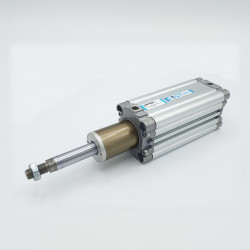
Compact cylinders are a more compact version of pneumatic cylinders with very narrow cylinder covers and extremely stable cylinder tube structures. They are usually smaller and have a shorter design. Compact cylinders are ideal for applications with limited space and offer a higher power density. Compact cylinders also come in a variety of sizes, with diameters ranging from 12mm to 100mm.
ISO cylinders
ISO cylinders are standardised according to the international standards ISO 6431 and ISO 15552. They have a standardised design and dimensions and are compatible with other ISO-compliant components. ISO cylinders can be built in various sizes and designs, with piston diameters ranging from 8mm to 125mm.
Characteristics of pneumatic cylinders
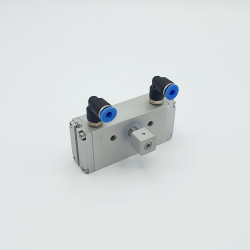
All three types of pneumatic cylinders have similar characteristics. They offer simple, fast and reliable linear movement and have a long service life. Pneumatic cylinders are generally less expensive than hydraulic cylinders and do not require special knowledge for installation and maintenance. They are also safer than hydraulic cylinders in explosive environments. In addition to these 3 types, there are of course many other types of cylinders, such as special cylinders (telescopic cylinders, rotary actuators, air actuators or guide units).
Conclusion
All in all, pneumatic cylinders offer a cost-effective, simple and reliable option for linear movement in pneumatic automation technology. The type of pneumatic cylinder must, of course, be selected to meet the requirements of the application and at the same time also bring the right properties for the given environmental conditions, which can vary depending on the location and type of application. Engineers and technicians must understand and correctly evaluate the specific requirements of the application, thus ensuring smooth operation and a long service life of the components.